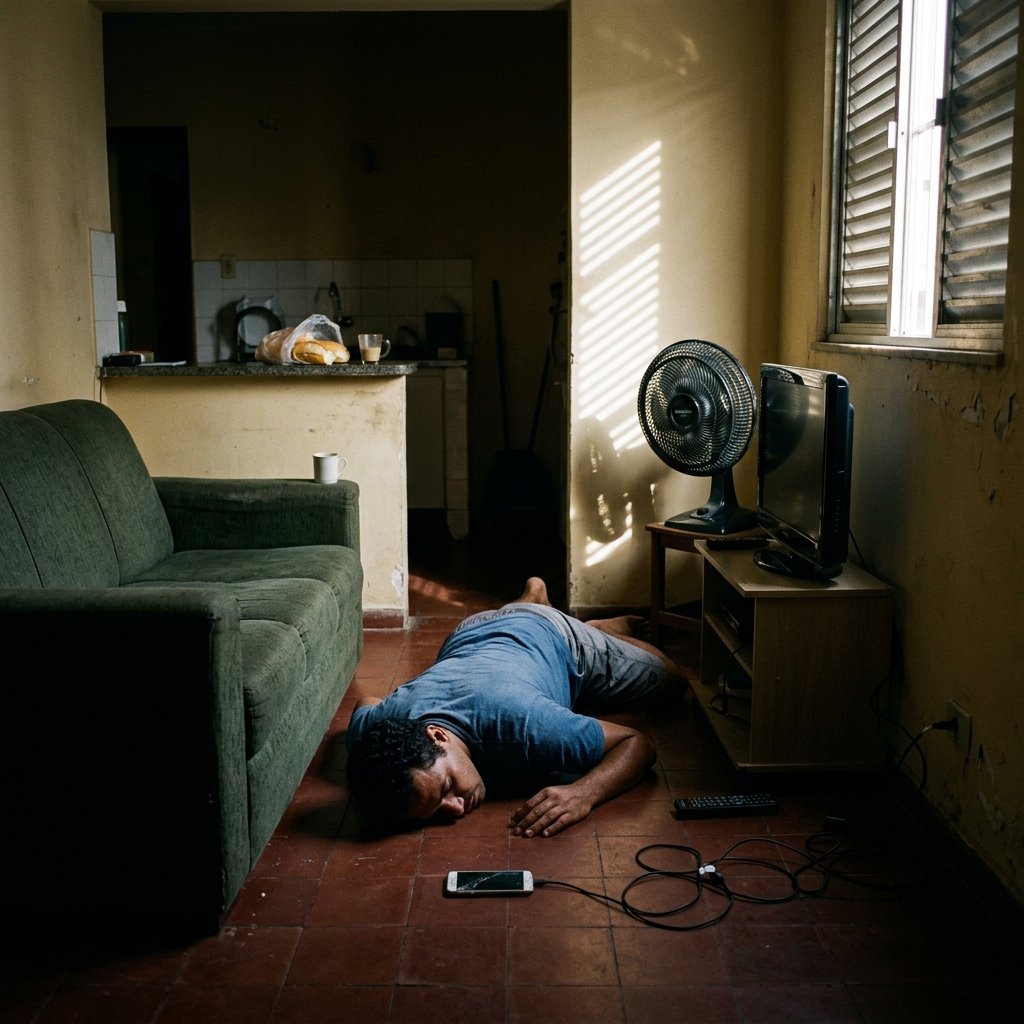
"When you work night shifts, the world operates differently. You sleep when others wake up. Nobody expects you to answer texts at 9 AM."
That simple assumption almost killed him.
What Is the "Invisibility Window"?
The Invisibility Window is the gap between when someone becomes incapacitated and when anyone actually notices they're gone.
It sounds obvious in hindsight. But in practice, it's invisible — by design. When someone's routine explains their silence, nobody questions the silence. Night shift workers sleep late. Remote workers work in bursts. Solo travelers lose signal. The social logic that protects their privacy becomes the exact mechanism that delays their rescue.
Josias was 34. He lived alone in an apartment in Palmas, Tocantins, Brazil, a mid-sized city in the country's interior. He worked the night shift at a printing press — 10 PM to 6 AM. His family, located in another city, knew his schedule well. They didn't call in the mornings. They never had.
On a Saturday in early 2023, he came home from his shift feeling dizzy. He assumed it was fatigue. He lay down on the sofa. He didn't wake up for 36 hours.
During that time, his phone sat on the coffee table — silent, charged, last seen on WhatsApp at 6:47 AM Saturday. His family checked the timestamp. They concluded: he's resting. He had a long week.
Medical literature consistently shows that in ischemic stroke cases — the type Josias experienced — the treatment window that preserves brain function is typically under 4.5 hours from onset (a threshold established in thrombolysis clinical guidelines). At 36 hours, the damage was extensive. He survived. His right arm did not fully recover.
Why Does This Happen — Even to People Who Aren't Alone?
The Invisibility Window isn't about isolation. It's about expected silence — and the social patterns that make that silence invisible.
Josias wasn't isolated. He had family. He had friends. He had a regular schedule that everyone knew. The exact thing that made him connected — a predictable routine — is what prevented anyone from questioning his absence.
This is the paradox of modern communication: we are more reachable than ever, but reachability requires the other person to reach. If your last WhatsApp status reads "Online 6:47 AM" on a Saturday, and you work nights, nobody fires an alarm. That timestamp is the alibi for your disappearance.
The same pattern repeats across very different demographics. A solo traveler on an overnight bus from Ho Chi Minh City to Hanoi, Vietnam, is expected to be offline for 8 hours. A senior living alone in São Paulo, Brazil, doesn't always pick up immediately. A remote worker in a Buenos Aires co-living space can vanish from Slack for a day without raising flags.
In each case, the absence is logical. The silence has an explanation. And the explanation is what kills.
Available data from emergency response research suggests that delayed discovery — when a person is found hours or days after an incident — significantly worsens outcomes across stroke, cardiac events, and fall injuries. The precise multiplier varies by condition, but the direction is consistent: time is the variable that matters most.
How Does Still Alive Prevent a Silent Emergency?
Still Alive works by reversing the assumption: instead of waiting for someone to call, it monitors for the absence of a signal.
The app doesn't track your location. It doesn't ping your contacts every hour. The mechanism is simpler — and more reliable. You set a check-in window (say, every 24 or 48 hours). Once per window, you tap "I'm okay." That's it.
The monitoring happens server-side. Not on your phone. This is the critical difference from conventional safety apps. If your phone runs out of battery, gets stolen, or breaks — the server is still watching the clock. When the window passes without a reset, Still Alive alerts your designated "Angels": the contacts you trust to act.
They receive a notification with your last check-in time and a clear message. No GPS coordinates. No drama. Just: they haven't confirmed they're okay. Check on them.
In Josias's case, a 24-hour window would have triggered an alert late afternoon on Saturday. His brother would have driven over that evening — not Monday morning. The outcome would have been different.
The system costs $1, once. No subscription. No monitoring service. The check-in algorithm runs independently of the device, which means the failsafe works even when the phone doesn't.
See also: how solo travelers use passive check-ins to stay safe without GPS tracking, and common questions about how the alert system works.
"The hospital said 30 more minutes and he wouldn't have made it at all. 36 hours of silence. It cost him his right arm, but it almost cost his life."
Don't Let Your Silence Be Dangerous.
One tap says you're okay. Silence does the rest. Still Alive alerts your Angels automatically — no GPS, no subscription, no drama.
Protect Your Presence — $1